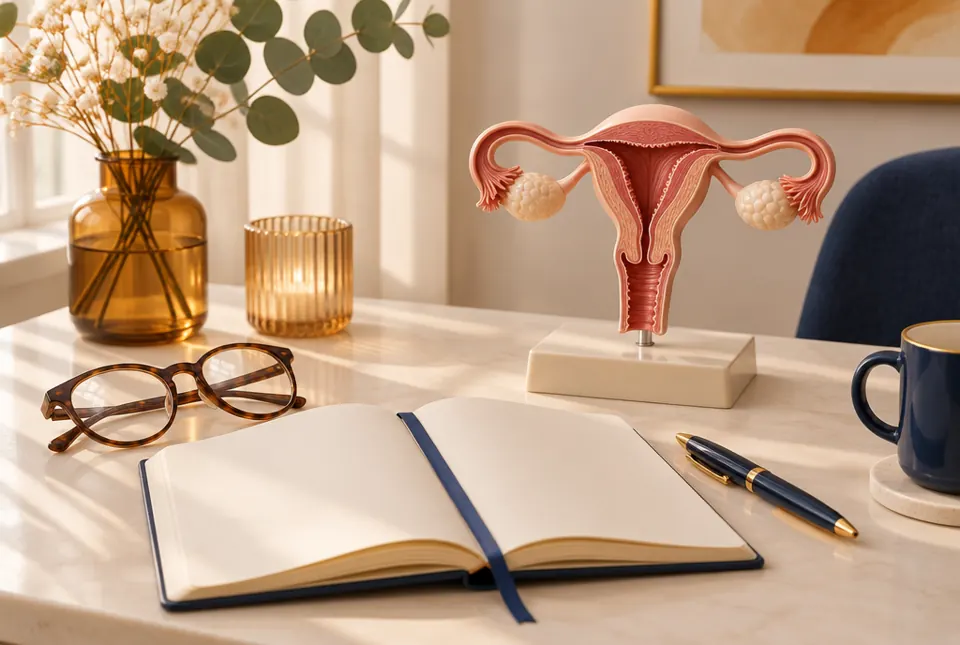
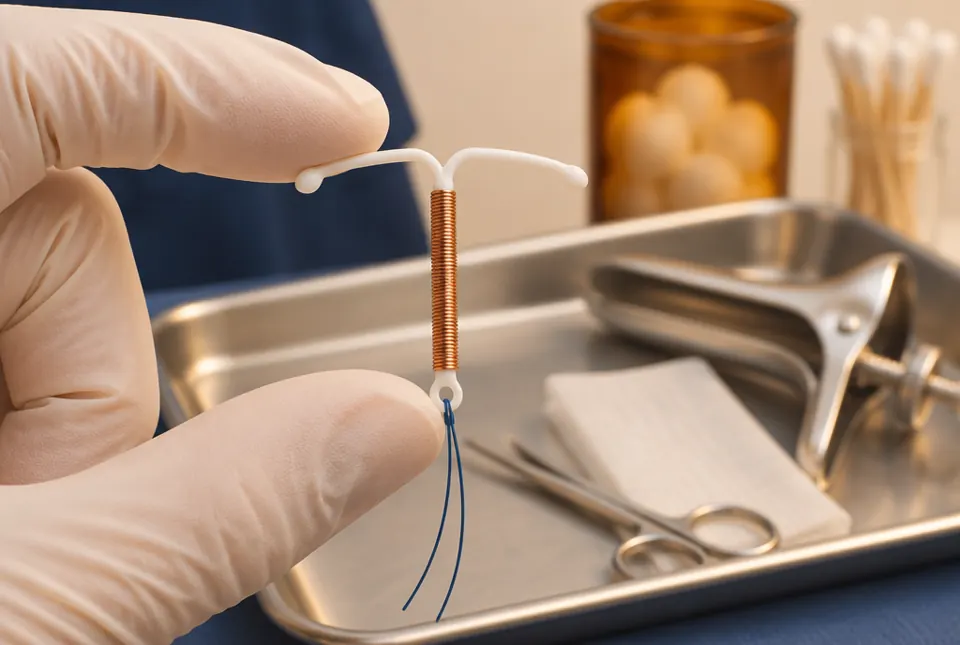
An IUD (coil) is a small device placed inside the womb and is a long-acting, reversible method of contraception. The copper type usually works for up to 10 years, and hormonal types generally for 3–8 years depending on the type; you will be told how long your particular device lasts. Insertion is a short outpatient procedure of a few minutes, and fertility usually returns quickly after removal.
Key facts
What is an IUD?
An IUD (intrauterine device, often called a coil) is a small T-shaped device placed inside the womb and is a long-acting, reversible method of contraception. There are two main types: the copper IUD and the hormonal intrauterine device (hormonal IUD). The copper type usually works for up to 10 years, and hormonal types generally for 3–8 years depending on the type.
When correctly placed, both types are very effective at preventing pregnancy and do not require you to remember anything daily. Which one is suitable depends on your period symptoms, medical history and personal preference. For a comparison with other methods, see the contraception methods page.
What is the difference between a copper IUD and a hormonal IUD?
The copper IUD contains no hormones. Copper works by preventing sperm movement and fertilisation. It is a suitable option for women who do not want to, or cannot, use hormones. In some women it can make periods heavier and more painful. When fitted within 5 days of unprotected sex, it can also be used as emergency contraception.
The hormonal IUD releases a small amount of a progesterone-like hormone into the womb. It thickens the mucus at the cervix, making it harder for sperm to pass, and thins the womb lining. In most women it reduces menstrual bleeding over time; for this reason it can also be used as a treatment for women with heavy periods.
There are different types of hormonal IUD with different sizes and amounts of hormone. Their duration of effect generally ranges from 3 to 8 years depending on the type and its licence; you will be told separately how long your particular device can stay in place.
Who should not use an IUD?
An IUD is a suitable method for many women, including women who have not given birth and adolescents. However, in some situations it is not fitted, or another assessment is needed first:
- Pregnancy or suspected pregnancy
- Active pelvic infection or an untreated sexually transmitted infection
- Unexplained vaginal bleeding
- Cervical cancer or cancer of the womb lining
- A large fibroid or abnormality of the womb's shape that clearly distorts the womb cavity
- For the copper IUD: an allergy to copper or Wilson's disease
- For the hormonal IUD: current breast cancer
If a fibroid inside the womb is suspected, see the fibroid treatment page for a detailed assessment.
When and how is an IUD fitted?
As long as it is certain that you are not pregnant, an IUD can be fitted on any day of the cycle. It is often preferred to fit it in the last days of a period or just afterwards, as it is easier to be sure there is no pregnancy at this time.
The procedure is done in the outpatient clinic, on the gynaecological examination couch, and usually takes 5–10 minutes:
- First, the position and size of the womb are assessed by examination and ultrasound.
- A speculum is inserted into the vagina and the cervix is cleaned with an antiseptic solution.
- The length of the womb cavity is measured and the IUD is placed inside the womb using a thin tube.
- The IUD threads are cut so that a few centimetres remain outside the cervix.
A brief cramp similar to period pain is common during the procedure. Some women feel temporarily dizzy, so it is recommended to rest for a few minutes afterwards.
Can an IUD be used after giving birth and while breastfeeding?
Yes. Both copper and hormonal IUDs can be used while breastfeeding; they are known not to have a negative effect on milk supply or the baby. An IUD can be fitted immediately after the placenta is delivered, at a vaginal birth or during a caesarean section, or more often at the check-up 4–6 weeks after the birth.
IUDs fitted immediately after birth have a slightly higher chance of coming out. Which timing is suitable can be discussed before the birth.
What should I watch for after an IUD is fitted?
For the first few days there may be cramping pain and light bleeding; these usually settle with simple painkillers. The first check-up is usually 4–6 weeks after insertion, and the position of the IUD is checked with ultrasound.
The copper IUD is protective from the moment it is fitted. If a hormonal IUD was not fitted within the first 7 days of a period, additional contraception is generally recommended for the first 7 days. An IUD does not protect against sexually transmitted infections.
You can learn to check for the threads with your finger after each period. If you cannot feel the threads, or if you can feel part of the IUD itself, you should use additional contraception and have an examination.
What are the side effects and risks of an IUD?
As with any medical procedure, an IUD has possible side effects and risks:
- Changes in bleeding: With the copper IUD, periods may become longer, heavier and more painful. With the hormonal IUD, irregular spotting is common in the first 3–6 months; after that, bleeding usually decreases.
- Expulsion: In about 1 in 20 women, the IUD may come out partly or completely on its own; this is most common in the first few months.
- Infection: The risk of pelvic infection is slightly increased in the first 3 weeks after insertion; after that, this extra risk disappears.
- Perforation of the womb wall: A rare complication, reported in about 1–2 per 1,000 insertions. The risk is slightly higher while breastfeeding and in the first months after giving birth.
- Ectopic pregnancy: An IUD greatly reduces the risk of pregnancy; however, if pregnancy does occur with an IUD in place, it is more likely to be outside the womb.
- Specific to the hormonal IUD: Some women may have temporary acne, breast tenderness, headaches or functional ovarian cysts.
How is an IUD removed?
An IUD can be removed when its duration of effect ends or at any time you wish. During an examination, the threads are gently pulled with forceps to remove it; this usually takes a few seconds. If the threads cannot be seen, removal may need ultrasound guidance or, rarely, office hysteroscopy.
If you do not want to become pregnant, a new IUD can be fitted at the same visit, or you can switch to another method. The hormonal rod placed in the arm is another long-acting option; details are on the contraceptive implant page.
Op. Dr. Özlem Katırcı sees patients for IUD fitting, check-ups and removal at Özel Erciyes Hastanesi (Erciyes Private Hospital) in Kayseri. For appointments and information, please use the contact page.
Frequently asked questions
Does it hurt to have an IUD fitted?
Most women feel a brief cramp similar to period pain during the procedure. The discomfort varies from person to person and may be a little more noticeable in women who have not given birth. If needed, a painkiller can be taken beforehand or a local anaesthetic applied to the cervix.
Does an IUD cause weight gain?
As the copper IUD contains no hormones, it is not expected to affect weight. With the hormonal IUD, the hormone acts mainly inside the womb, and no clear link with weight gain has been shown. Even so, some women may notice mild hormonal side effects such as breast tenderness, acne or a bloated feeling; these often settle within the first few months.
Can you get pregnant straight after an IUD is removed?
Yes, fertility usually returns shortly after the IUD is removed. So, if you do not want to become pregnant, it is recommended to switch to another method at the same time as removal.
How soon after giving birth can an IUD be fitted?
An IUD can be fitted immediately after the birth or, more often, 4–6 weeks after giving birth. Both copper and hormonal IUDs can be used during breastfeeding, after either a vaginal birth or a caesarean section.
What should I do if I can't feel the IUD threads?
The threads sometimes curl up and cannot be felt; this does not always mean there is a problem. However, because the IUD could have moved out of place, it is recommended to use additional contraception until you are examined and to have an ultrasound check.
Does a hormonal IUD stop periods?
In most women using a hormonal IUD, menstrual bleeding decreases over time, and in some it may stop completely. This is not harmful, and periods return when the IUD is removed. Irregular spotting is common in the first few months.
This page is for general information; diagnosis and treatment require a medical consultation. Last updated: 23 November 2026