There are many ways to prevent pregnancy: hormonal and non-hormonal, short- and long-acting, reversible and permanent. Much of the difference in effectiveness comes from how easy a method is to use: with long-acting methods such as the IUD and the implant, fewer than 1 in 100 women become pregnant in a year, while the rate is higher with methods that need regular attention. The right method is chosen together at a consultation, based on your health, breastfeeding, smoking, future pregnancy plans and personal preference.
Key facts
What contraception methods are there?
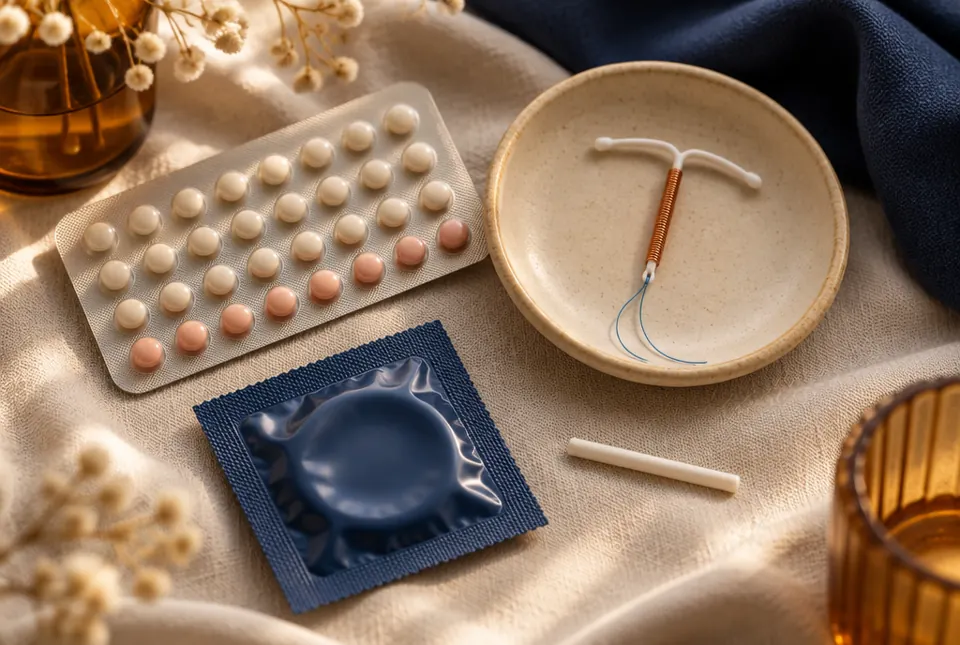
Contraception methods include barrier methods such as condoms; hormonal methods such as the pill, the injection, the vaginal ring and the patch; long-acting methods such as the IUD (coil) and the implant; and permanent methods such as tubal ligation and vasectomy. None of these is the single right choice for everyone. The right method depends on your health, age, breastfeeding, pregnancy plans and personal preference.
Much of the difference in effectiveness between methods comes from how easy they are to use rather than from the method itself. Methods that must be remembered every day or used every time you have sex leave room for forgetting and mistakes. With methods that work for years once fitted, this room almost disappears.
Comparing the methods
The "typical use" figures in the table below are approximate values widely used in World Health Organization (WHO) and US Centers for Disease Control and Prevention (CDC) sources. Typical use means real-life use, including occasional forgetting and mistakes.
| Method | How it is used | Pregnancies per 100 women per year with typical use |
|---|---|---|
| Contraceptive implant | Under the skin of the arm, 3 years | Fewer than 1 |
| Hormonal IUD | Inside the womb, generally 3–8 years depending on type | Fewer than 1 |
| Copper IUD | Inside the womb, usually up to 10 years | Fewer than 1 |
| Tubal ligation | Permanent, by surgery | Fewer than 1 |
| Vasectomy (in men) | Permanent, by a minor procedure | Fewer than 1 |
| Three-monthly injection | An injection every 3 months | About 4 |
| Contraceptive pill (combined or progestogen-only) | Every day | About 7 |
| Vaginal ring | Inserted once a month | About 7 |
| Skin patch | Changed once a week | About 7 |
| Male condom | Every time you have sex | About 13 |
| Natural methods (calendar, body signs) | Avoiding sex on fertile days | About 2–23 (depending on the method) |
The availability of the vaginal ring and the skin patch in Turkey can change from time to time; it is advisable to ask about the current situation at your consultation or at a pharmacy. Although withdrawal is not in the table, it is commonly used; the chance of pregnancy is clearly higher than with long-acting methods.
Long-acting and permanent methods
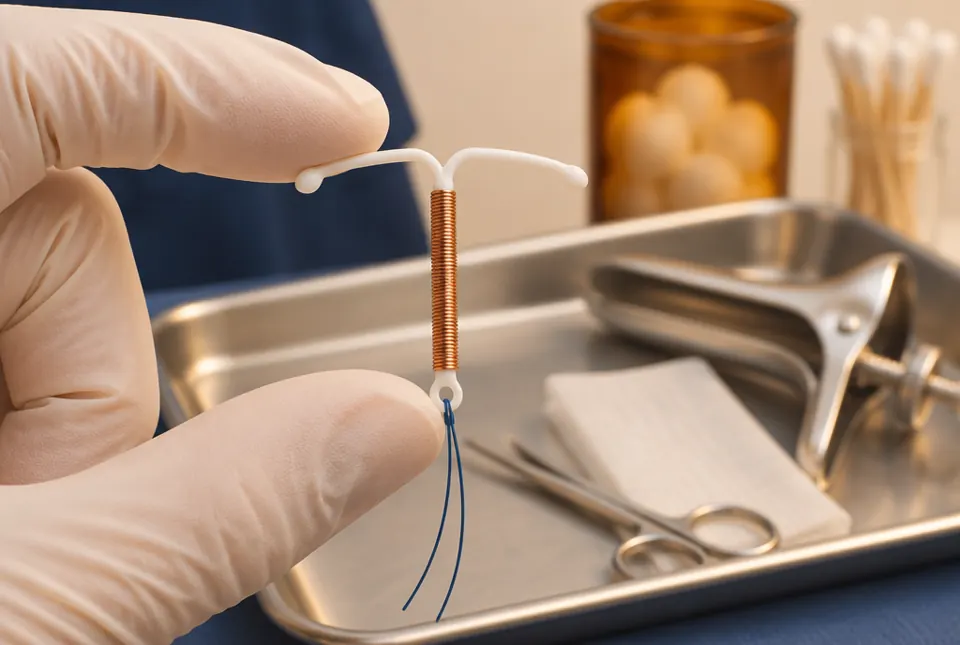
The copper IUD and hormonal IUD are small devices placed inside the womb. The copper IUD contains no hormones; the hormonal IUD reduces menstrual bleeding in most women. Details are on the IUD and hormonal IUD page.
The contraceptive implant is a single rod placed on the inner side of the upper arm and protects for 3 years; its most common side effect is irregular bleeding. For more information, see the contraceptive implant page, which also compares it with the IUD.
Permanent methods are for people who are sure they will not want more children. In women, tubal ligation is usually done by laparoscopy. In men, vasectomy is a smaller procedure; however, it does not work immediately, and additional contraception is needed until a semen test confirms the result.
The pill, injection, ring and patch
The combined contraceptive pill contains oestrogen and a progestogen and suppresses ovulation. It can regulate periods and reduce period pain. The ring and the patch contain the same two hormones and work in a similar way.
The progestogen-only pill contains no oestrogen; it is an option for women who are breastfeeding or for whom oestrogen is not suitable. It is important to take it at the same time every day.
The three-monthly injection also contains no oestrogen. With long-term use, a reversible decrease in bone density may occur, and after stopping the injection it can take from a few months to about a year for fertility to return. This is taken into account for women planning a pregnancy in the near future.
What should I consider when choosing a method?
- Breastfeeding: Methods containing oestrogen are generally not recommended, especially in the first weeks after birth. The IUD, implant, progestogen-only pill and injection can be used while breastfeeding.
- Smoking and age: Methods containing oestrogen are not recommended for women over 35 who smoke, because of the risk of blood vessel blockage.
- Migraine and history of blood clots: Oestrogen-containing methods are not used in women who have migraine with aura or who have had a clot in the leg or lung; non-hormonal or progestogen-only methods are considered instead.
- Future pregnancy plans: If pregnancy is planned soon, methods whose effect wears off quickly after stopping are preferred; if not planned at all, long-acting or permanent methods come to the fore.
- Period symptoms: With heavy or painful periods, the hormonal IUD or combined pill can ease symptoms; the copper IUD, on the other hand, may increase bleeding.
Blood pressure, weight, medicines and long-term conditions are also part of the assessment. Medicines that affect liver enzymes, such as some epilepsy and tuberculosis medicines, can reduce the effectiveness of some hormonal methods; in this case, options that are not affected, such as the copper IUD or the hormonal IUD, can be considered.
Contraception after giving birth
In women who are not breastfeeding, ovulation can start about 3 weeks after the birth. As the first period comes after ovulation, pregnancy can occur before any period. For this reason, it is advisable to discuss a method before the birth.
If all three of these conditions are met — feeding the baby only breast milk, periods not yet having returned, and the baby being under 6 months old — breastfeeding can provide some protection. As soon as one of these conditions no longer applies, another method is needed. An IUD can be fitted straight after the birth or 4–6 weeks later, and the implant at any time after the birth.
Protection from sexually transmitted infections
Of the methods listed here, only the condom also protects against sexually transmitted infections. Women using an IUD, implant, the pill or tubal ligation are also advised to use condoms if they have a new partner or more than one partner.
When should I see a doctor?
It is advisable to have a consultation before starting a new method, if you have side effects from your current method, if your period is late and you suspect pregnancy, or if you are considering a permanent method. If you are thinking of stopping your current method, it is worth discussing in advance how to switch to a new one without a gap.
Op. Dr. Özlem Katırcı sees patients for choosing a contraceptive method, fitting IUDs and implants, and permanent methods at Özel Erciyes Hastanesi (Erciyes Private Hospital) in Kayseri. For appointments and information, please use the contact page.
Frequently asked questions
Which contraceptive method is more effective?
Methods that do not require you to do something every day or every time you have sex are more effective in practice. With the copper IUD, hormonal IUD, implant, tubal ligation and vasectomy, fewer than 1 in 100 women become pregnant in a year with typical use. Which method suits you depends on your medical history and expectations.
Can everyone use the contraceptive pill?
No. The combined pill, which contains oestrogen, is generally not recommended for smokers over 35, women who have migraine with aura, women with a history of blood clots, or women who are breastfeeding in the first weeks after birth. In these situations progestogen-only or non-hormonal methods can be considered.
When do I need contraception after giving birth?
In women who are not breastfeeding, ovulation can start as early as about 3 weeks after the birth, so it is recommended to discuss a method before the birth and start early. Women who are breastfeeding can also become pregnant before their periods return.
Is the withdrawal method reliable?
With withdrawal, the chance of pregnancy is clearly higher than with long-acting or hormonal methods. If you do not want to switch to a more effective method, it is advisable at least to use it together with condoms and to know your emergency contraception options.
Does contraception cause infertility?
When the IUD, implant, pill, ring or patch is stopped, fertility usually returns soon. With the three-monthly injection, this can take from a few months to about a year. Tubal ligation and vasectomy are permanent methods.
This page is for general information; diagnosis and treatment require a medical consultation. Last updated: 23 November 2026